
Mac
The Apple world: a permanent revolution in the service of performance
Since its creation, Apple has established itself as the radical alternative to the Windows world. While history remembers the boldness of its first Xerox-inspired windowed interfaces, it is its ability to reinvent the computer that forged its legend. From the legendary Macintosh Plus to the "all-in-one" design that won over a whole generation, the brand has always favoured a perfect fusion of innovative hardware and a user experience of unrivalled fluidity.
The return of co-founder Steve Jobs in 1997 marked the start of an era of cascading revolutions: the iMac redefined desktop computing, while the iPhone and then the iPad literally invented the standards of modern mobility. Often imitated, Apple remains the pioneer that sets trends and usage.
In recent years, the Cupertino company has dealt the decisive blow on the historic home ground of the Microsoft/Intel duo: raw power. By rolling out its own chips (Apple Silicon), the brand broke the PC world's dominance, offering graphics capability and battery life previously out of reach for mobile products. Today, Apple is a major player winning record market share in every professional segment - from graphics workstations with multiplied capabilities to mobile workstations combining computing power, graphics performance and battery life - and offers ultimate production tools for those who accept no compromise.
Even so, in 2026 we still keep some of the last generations of Intel Macs (i7 / i9 or Xeon processors) in our rental catalogue: although the M1 Pro chip of the Apple Silicon era already outperforms the most powerful Intel MacBook Pro by 50% and is only beaten by the 2019 Mac Pro, these machines still have strong arguments:
Budget optimisation: With equal memory (64 GB), an Intel MacBook Pro costs around 50% less to rent than an M1 Max model.
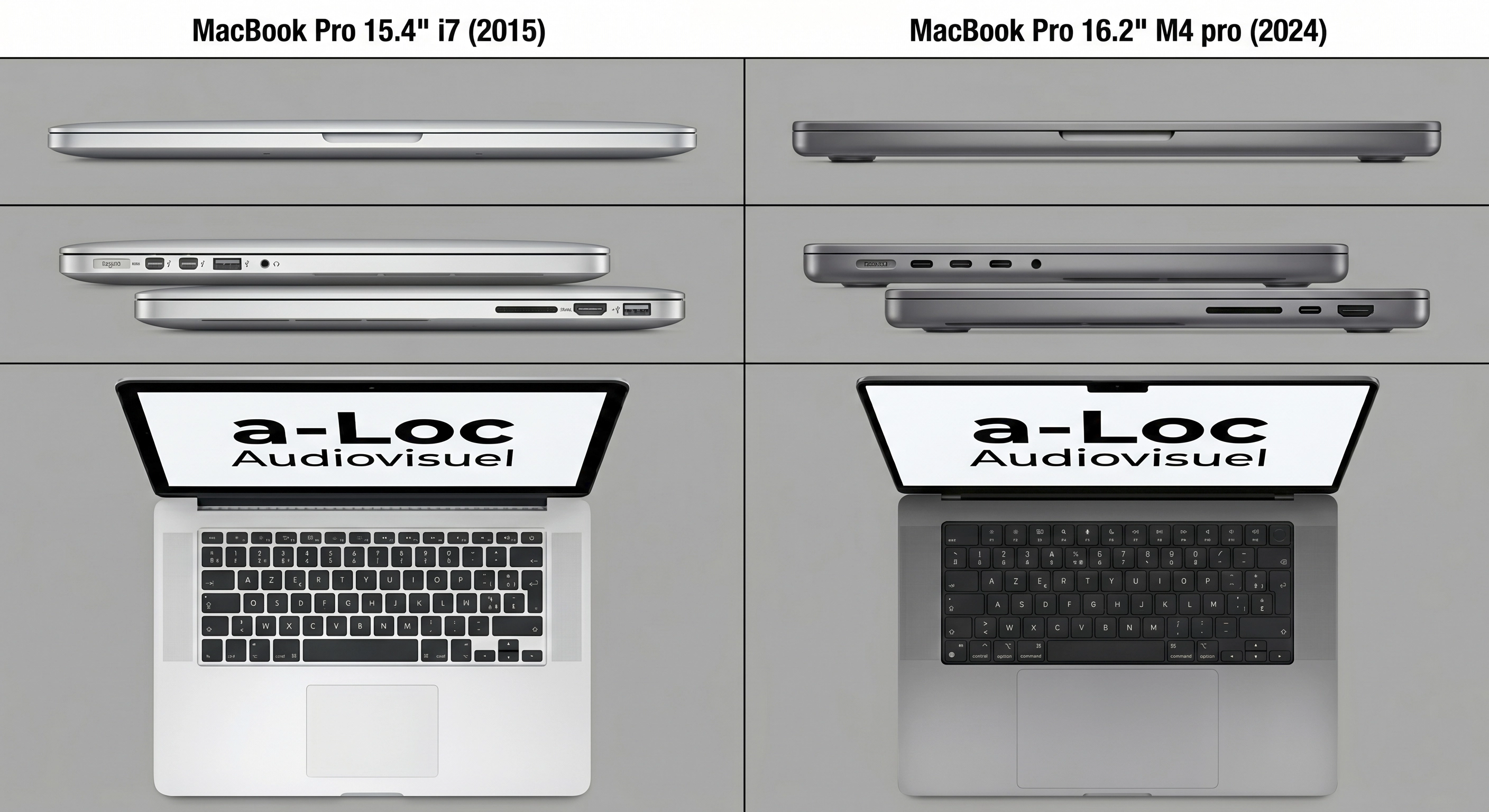
Compactness: A thinner, sleeker design than the Apple Silicon generations, often seen as bulkier and heavier.
Memory architecture: Unlike the unified memory of M chips, these models separate the processor's RAM from the graphics card's dedicated memory. An i9 MacBook Pro with 64 GB of RAM and 8 GB of graphics memory therefore gives the processor greater computing capacity.
Software compatibility: Some specific applications or environments that need an x86 architecture (or native Windows boot) remain more stable on Intel Mac configurations; note that Boot Camp, which lets you boot a Mac natively into Windows, is no longer available on M-series Macs; to run Windows on an Apple Silicon Mac you need a virtual machine such as Parallels Desktop… and the least we can say is that it is not bug-free!
MacBook Pro, MacBook Air
Long lagging behind Windows laptops with Intel processors, Apple did more than reshuffle the cards with the arrival of Apple Silicon chips: in the high-end MacBook Pro segment, it suddenly became the leader in battery life, computing power and graphics power. This architecture now allows audiovisual professionals and developers to stay fully productive away from the studio; Apple remains, of course, the leader in high prices: that's the trade-off, the "chef's signature"! As the photo opposite shows, Apple has made concessions on looks: the new Apple Silicon MacBook Pros are understated, but noticeably bulkier and heavier than their Intel predecessors.
Mac Studio, Mac Pro
Despite the resilience of Intel configurations, the advent of the Apple Silicon architecture marks the brand's big comeback at the top of professional graphics workstations.
Between 2000 and 2010, while QuarkXPress and Adobe suite users (Premiere, After Effects, Photoshop) swore only by the Mac, the raw performance gap widened in favour of the Windows world. This gradual migration of professionals to the PC world was accentuated by Apple's slowness to renew its machines. Creatives had to bide their time: after the launch of the Mac Pro in 2006 and its 2009 updates, it took until 2013 to see the famous cylindrical chassis - which some mockers quickly nicknamed the "trash can Mac". Six years of stagnation followed before the last generation of Intel Mac Pros, the final evolution of the tower chassis, like a return to the roots of Power Mac design for connoisseurs.
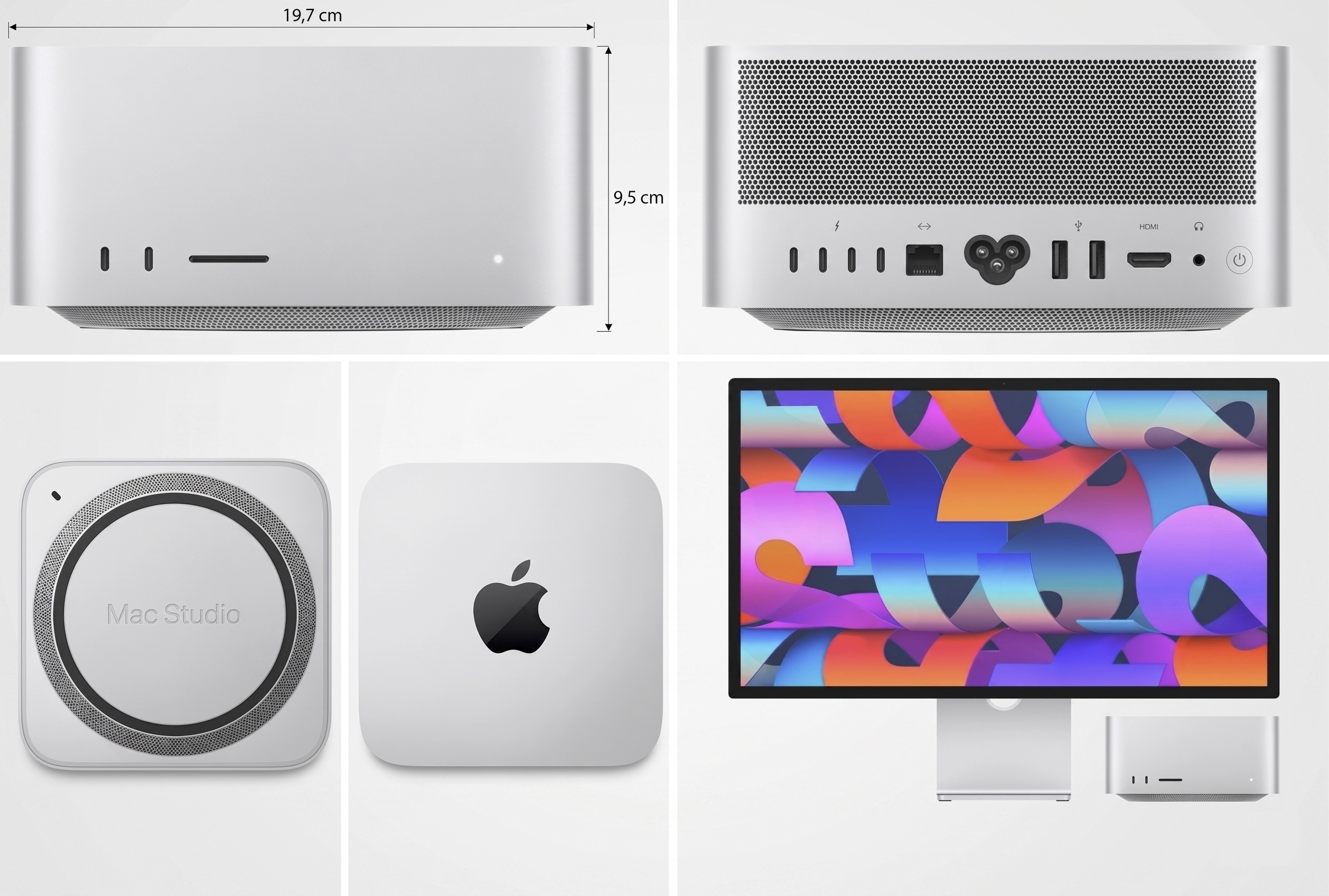
Yet the real recapture of market share did not come from the prestige of the Mac Pro alone. It was born of the Silicon technological breakthrough, which integrates a massive number of graphics cores right at the heart of the architecture. The spearhead of this revival is undoubtedly the Mac Studio: a machine fitted with the fastest processors in the range (M2/M3 Ultra), able to handle colossal workloads in rendering software such as DaVinci Resolve or Maxon Cinema 4D in an ultra-compact format.
By dropping the traditional model of third-party graphics cards in favour of extremely fine chip engraving, Apple now offers cutting-edge performance in a small footprint - even if, true to form, the brand has not lowered its prices.
Today, the Mac Studio captures most of the power once reserved for the Mac Pro. The shift is such that, at the end of the first quarter of 2026, Apple confirmed the definitive end of the Mac Pro, whose expandable design and tower format had become anachronistic in the face of the full integration of Silicon chips. From now on, the power once reserved for this legendary tower is concentrated in the Mac Studio, making it the preferred choice for our high-performance rental solutions. The need for a large case now survives only in a few very specific niches; for the vast majority of production workflows, the speed of Thunderbolt 4 and 5 interfaces has made internal cards obsolete.
iMac, Mac Mini
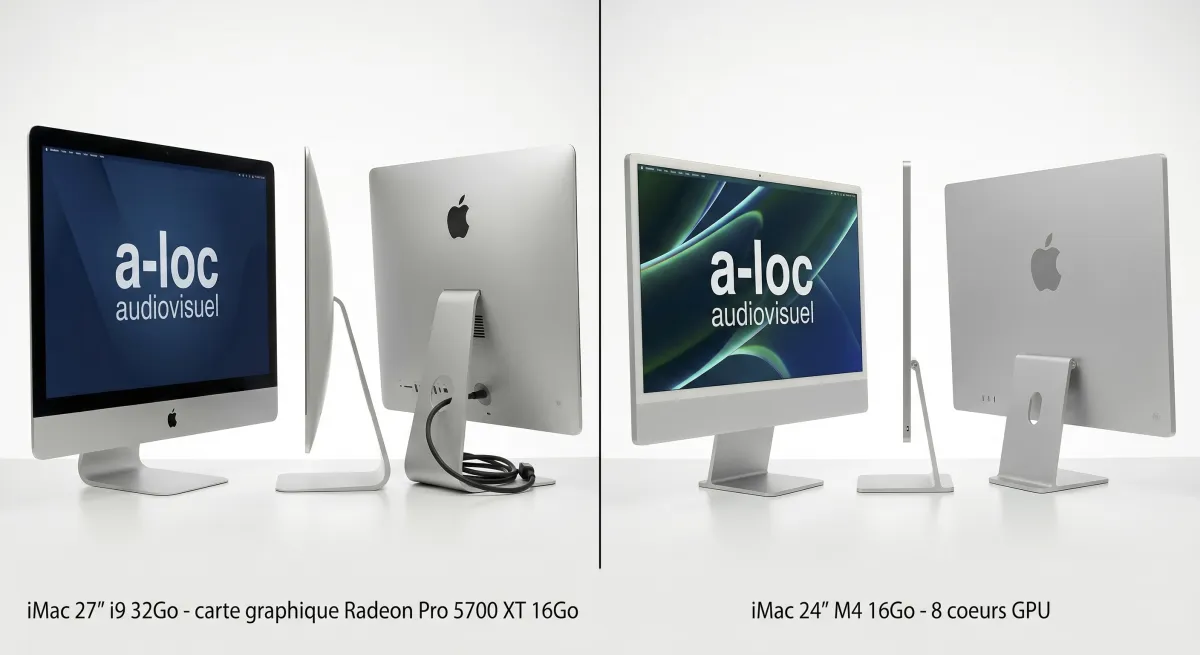
In the Intel processor era, Apple successfully offered robust mid-range solutions for 2D graphic designers, illustrators and layout artists, notably the 27" 5K iMac with Xeon or i9 processors. These configurations are still relevant today for moderate graphics needs: a 27" 5K iMac (3.6 GHz Core i9, 32 GB of RAM and a Radeon Pro GPU with 16 GB of dedicated memory) remains a very comfortable workstation for layout or photo retouching.
In switching to the Apple Silicon architecture, however, the Cupertino company gave up this integrated mid-range. The strategy now is to steer demanding users towards the Mac Studio paired with the Studio Display, while the "all-in-one" iMac has been repositioned in the advanced office segment. Limited to a 24" 4.5K screen and the least powerful chip in the range (10 CPU/GPU cores versus 32 CPU cores and 80 GPU cores for the top of the range in 2025), this iMac effectively replaces the old 21.5" model. With a maximum of 32 GB of RAM - far from the 256 GB available on a Mac Studio - it has now become an elegant solution for tight budgets and short-term rental needs (trade fairs, training).
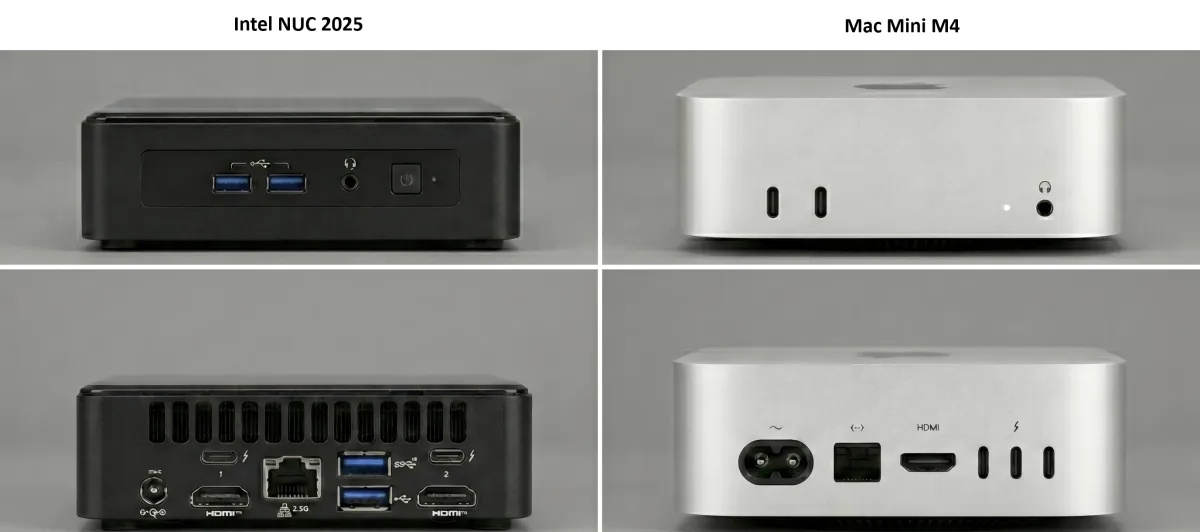
This office and project management segment is completed by the Mac Mini, whose M4 version with front USB-C/Thunderbolt ports finally offers a truly compact design. Although Apple is often a pioneer in miniaturisation, it was a century behind - in computer years -: while Intel's first NUCs already measured 11 cm per side and weighed 500 grams in 2012, it took until 2024 for the Mac Mini to give up its 20 cm case and adopt a pocket-sized format (12.7 x 12.5 cm). This change makes it the ideal tool for temporary office set-ups where footprint is decisive. These features make the Mac Mini M4 an ideal choice for simple IT deployments and for quickly setting up Apple-based training rooms.
To show these differences in footprint, format and connectivity in practice, we have produced exclusive comparisons with other industry standards.
iPad, iPhone
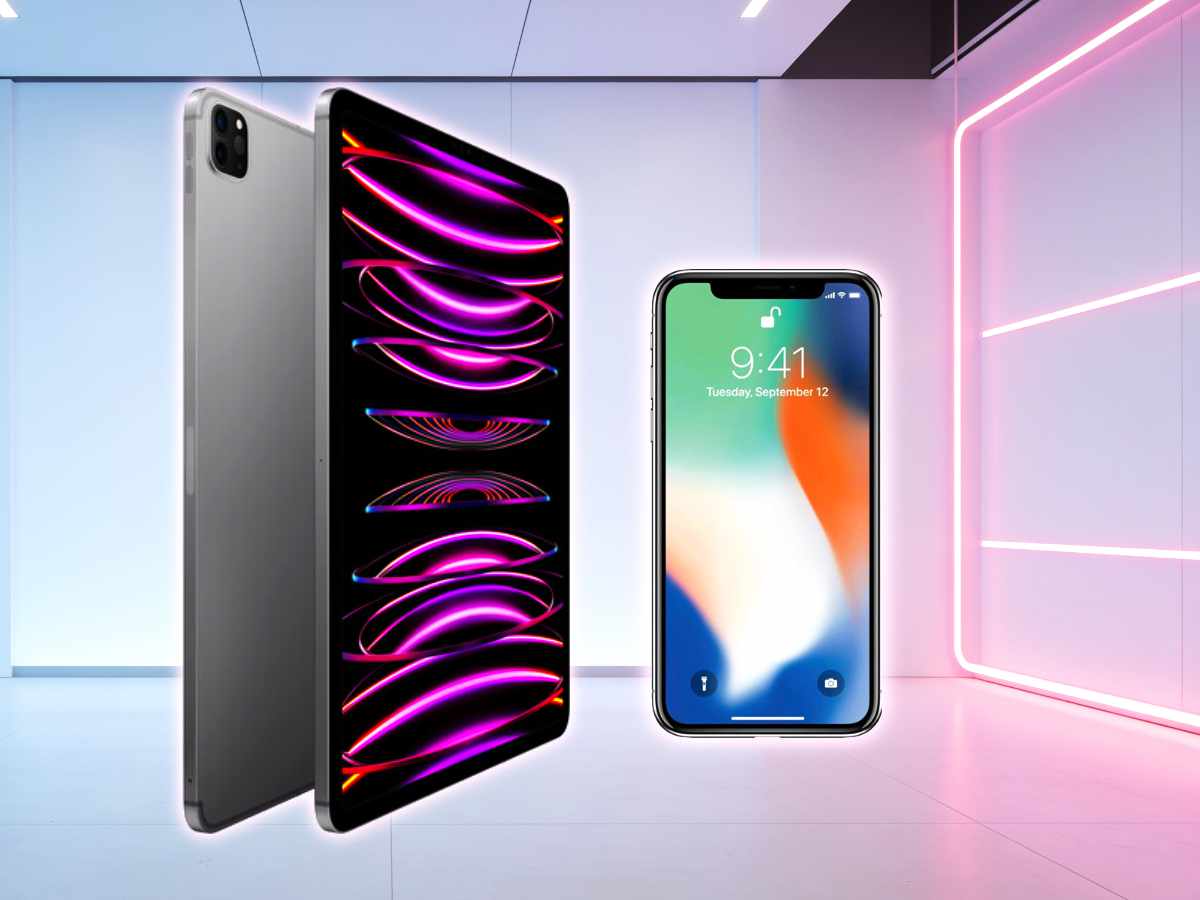
While the computer remained the pivot of Apple's creativity and originality for almost three decades, the late 2000s marked a major expansion of its world, a small big bang on the human scale of computing, and at the very least on Apple's scale! By moving beyond the keyboard in favour of touch interaction, Apple added two new pillars to its expertise, which have now become the brand's economic centre of gravity, each ushering in a new era of digital communication: the tablet and the smartphone.
With remarkably innovative boldness, the brand created two distinct paths, raised in 15 years to the rank of new communication highways: the iPad, a true standalone tool that people were unconsciously waiting for, the obvious answer that finally combines the power of a computer with the flexibility of touch for creative work on the move; and the iPhone, which propels the Apple ecosystem into total mobility. By natively integrating telephony and cellular connectivity, the iPhone does more than offer a smart touch interface; it opens up a global world of communication, giving everyone, individuals and professionals alike, unprecedented responsiveness, permanently and everywhere.
Apple peripherals and accessories
A Mac workstation or an iPad kiosk on a stand is never enough on its own: an extra keyboard and trackpad, USB-C adapters and hubs, chargers, docks or a compatible external screen secure an installation that has to last the whole trade fair without depending on a single cable or a single port.
This subcategory brings together all these Apple accessories, designed to complement a workstation, a demo or a reception point already equipped with a Mac, iPad or iPhone.
Products will soon be available in this equipment category.
Tell us about your project.
Contact us today to bring your vision to life.